

Securitised Credit
Synopsis
Commercial Mortgage-Backed Securities (CMBS) is a sector in Securitised Credit that has come under pressure recently. However, we believe that each sub-sector is being painted with the same brush as the more problematic areas.
- To navigate these challenges and extract real value from this bifurcated asset class, comprehensive due diligence is required
There are three key reasons driving the weakness at a sector level:
- Persistently high interest rates have led to increased borrowing costs for new borrowers significantly raising the expense of refinancing existing loans upon maturity
- Property valuations, which are inversely related to interest rates, have decreased compared to pre-2022 levels due to rising property yields. Consequently, lenders are offering reduced refinancing amounts and existing loan-to-value ratios may increase unless, borrowers inject additional equity
- Changing property trends – over the past decade, shifts in property usage, intensified by the COVID-19 pandemic, have altered market demands. The transition to hybrid working models and the growth of e-commerce have reshaped the need for office spaces, distribution centres, and retail properties
The factors above highlight the importance of selecting:
- Securitisations on fit-for-purpose properties, that is, properties that do not require significant costs to maintain, are in a good location and are not inhibited by their age or type of use
- High quality tenants in sectors more likely to outperform in the current economic cycle
- Securitisations that have well-structured lease structures, the right blend of tenants and high occupancy rates
As a result of the sector coming under pressure, spreads are at historical wides.
Due to the sector's pressures, spreads are wider. Therefore, selecting high-quality CMBS securities could enable investors to earn attractive risk-adjusted returns and secure compelling yields. As we move into the next cycle, with anticipated lower interest rates, the asset class could benefit from spread tightening and capital appreciation as transaction volumes increase, property values rise, and the cost of financing falls.
What is a CMBS?
A CMBS is a fixed-income investment product that is backed by mortgages on commercial properties. A typical CMBS structure is illustrated below consisting of different types of bonds at different risk tranches. This allows investors to pick their desired risk level.
Fixed rate CMBS illustration
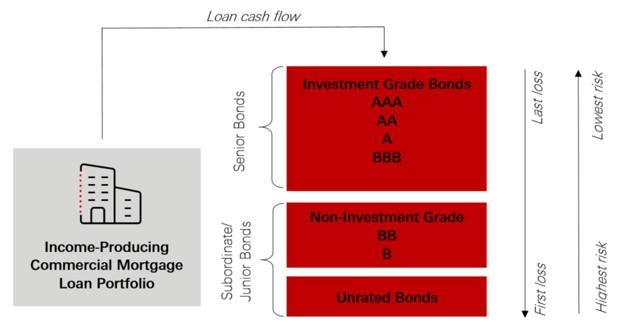
Source: HSBC Asset Management. The information provided is for illustrative purpose only.
The importance of due diligence
Selecting the right type of property is key. The change in demographics has meant that there are winners as well as losers across the different sub-sectors of CMBS.
Conduit CMBS: One area that has come under scrutiny, and where a lot of the stress in CMBS lies, is conduit CMBS. These are securitisations where the underlying properties are a pool of loans which has diverse asset types such as offices, retail, hotels, apartments, self-storage etc. The asset quality is usually not prime for these asset types. It is thus no surprise that we do not invest in this area.
Instead, we take a rifle shot approach, focusing on “Single Asset, Single Borrower (SASB)” CMBS.
A SASB CMBS is where the securitisation is secured on a single property or a portfolio of similar properties with one institutional sponsor/borrower.
Sub-sectors
Office: All secondary real estate is underperforming, but secondary offices are currently in the spotlight.
The hybrid working environment we now find ourselves in has resulted in a significant reduction in the demand for secondary office space.
Investors in Conduit CMBS specifically could be inadvertently exposed to:
- Outdated office properties which are not fit for purpose and require significant investment
- Vacant office floors, due to fewer tenants
- Buildings located in areas which have become obsolete
Our SASB focus, as it relates to Office, allows for two things:
- Sourcing of deals backed with “trophy buildings”: We focus on acquiring high-quality properties that are well-suited to the current economic climate, adhere to advanced energy standards, and are in prime areas
- Transparent evaluation of borrowers: Our approach involves evaluating individual borrowers or sponsors rather than pools. We engage in transactions with top-tier sponsors who are both experienced and financially robust
Vacancy rates can very dramatically from region to region. By selecting prime and “Trophy” office buildings, we benefit from reduced vacancy rates—approximately 5 per cent lower (as can be seen in the chart from CBRE below), and the ability to command higher rental prices (as evidenced by the second chart below from Avison Young). So selecting the right type of property in the right area is key.
Prime vs Non-Prime office vacancy rates in Top 20 US markets
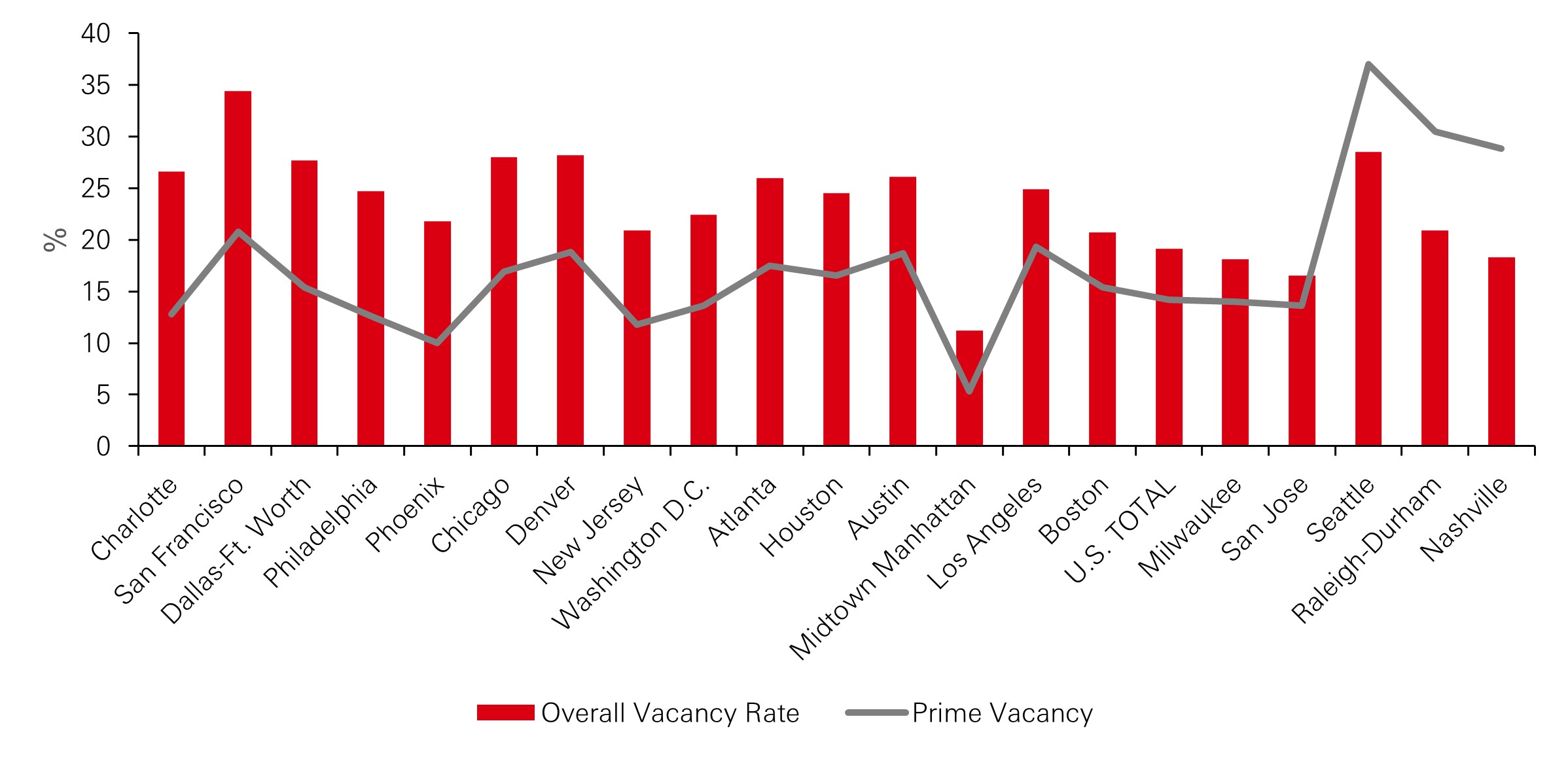
Source: CBRE Econometric Advisors, CBRE Research, Q3 2025
Trophy vs Class A vs Class B/C office asking rent

Source: Avison Young Market Intelligence, Q2 2025
As a result of this focused investment process, there are three SASB office CMBS areas that have interesting features:
- Life Sciences: While many employees can work from home, Life Sciences requires the use of laboratory spaces and experimentation and testing for vaccines cannot be done remotely. As a result, these properties have generally performed well and rents are at a premium to offices in the same markets, as can be seen below:
- Industrial: Whilst the retail market is increasingly going online, goods to be delivered to the end consumer must be stored and distributed to their homes. Unsurprisingly, warehouses which store these goods and last mile distribution/logistics is an area that has directly benefitted
Overall Asking Rents, Q2 2025
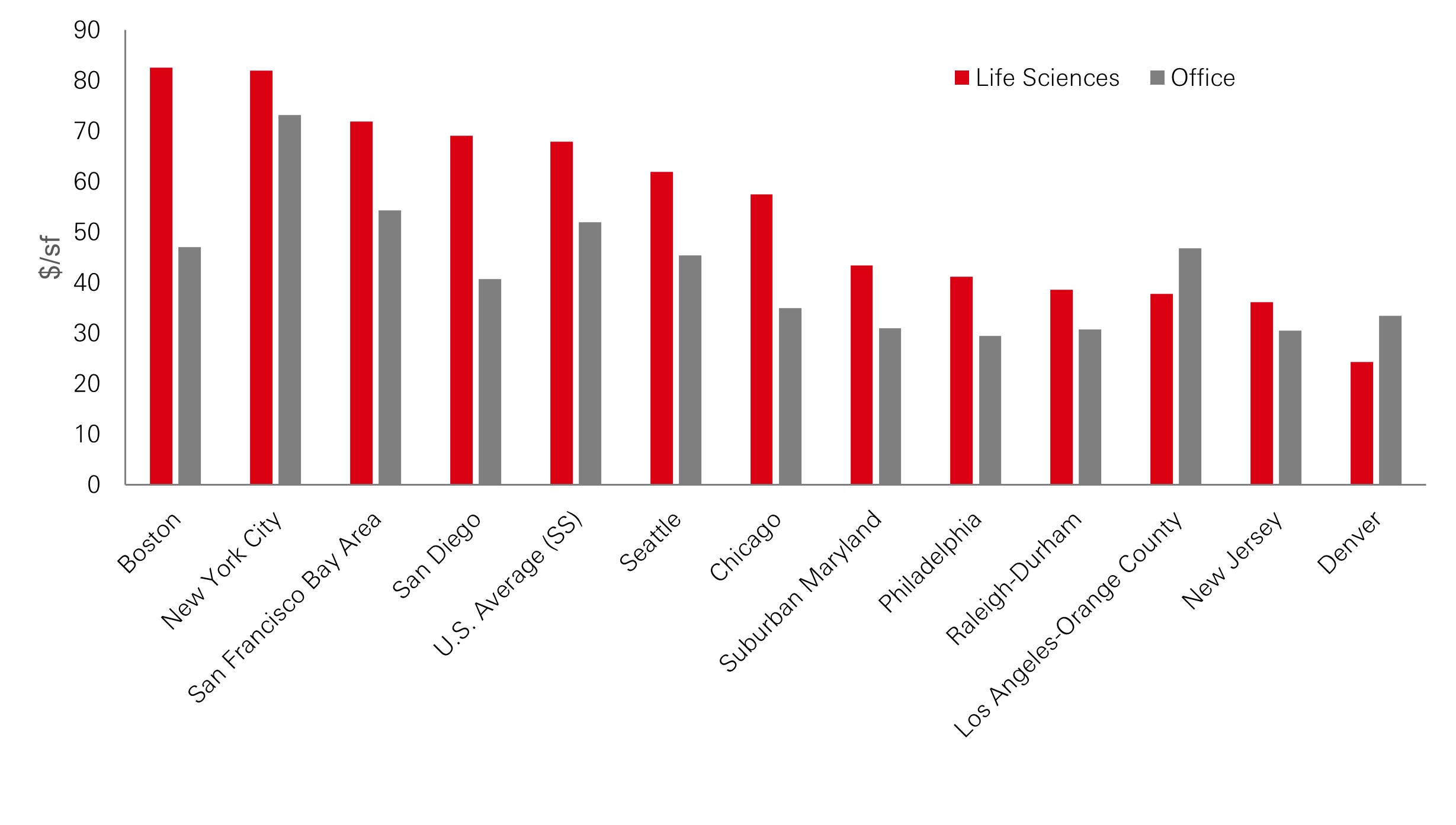
Source: Cushman and Wakefield, HSBC Asset Management
- Data centres – the future: In the ever-increasing digital world we are in; data is a fundamental requirement. However, data needs to be stored and utilised. As a result, data centres have a very important role to play, and demand is showing no signs of slowing
New construction has only partially met demand and thus rents for wholesale data centres are likely to continue to rise. In fact, a report by Jefferies estimates that data centre growth will grow at a compound annualised growth rate between 10–20 per cent globally to 2030
Retail: The death of the shopping mall has been a longtime coming. There is no doubt that retail has changed over the past two decades. As technology continues to advance, it has become easier and easier to order and consume goods and services remotely. Consequently, secondary retail shopping malls and high street properties have arguably gone out of vogue. COVID-19 undoubtedly accelerated this trend.
However, some areas of retail remain popular. For instance, grocery-led out of town supermarket complexes (next to retail stores) and super regional malls continue to see strong demand.
Multifamily CMBS: In this area of CMBS, size and scale matters. We tend to prefer large rented units, that is, purpose-built apartment buildings specifically designed to be let out to tenants.
Hotel: The seasonality and demand elasticity of hotels has also resulted in us avoiding this sector.
Structural features
Once investors have picked the correct sub-sectors within the asset class backed by top tier sponsors, the structural features of the securitisation are just as important. It is crucial to consider four elements
- Tenants and the mix of tenants:
The tenants are the income stream of the securitisation. It is therefore of paramount importance that the tenants comprising the loan are suitable. Not only do we typically invest in the higher rated tranches of securitisations, but the underlying tenants are also predominantly high-quality tenants - Lease terms:
In some CMBS deals, there can be instances where the leases for the tenants runs out before the end of deal term. In these cases, and especially where a tenant comprises a significant portion of the property, there are risks that the tenant doesn’t renew their lease, a new tenant is not sourced or there is a period of time where the property remains untenanted whilst a new tenant is found.
Selecting securities where the lease terms are longer than the maturity of the deal or there is only a small proportion of leases that expire before the deal term is therefore necessary - Occupancy rates:
An ongoing concern is the occupancy rate of the properties. While it is unlikely that every CMBS deal is always fully occupied by its tenants, should the occupancy rate fall to an unsustainable level (that is, impacting the rents received by the sponsor/borrower), this could be a cause for concern.
We evaluate deals based on their occupancy rates at the time of investing as well as applying stress tests to ensure that should occupancy fall noticeably; the tranches we invest in are adequately protected - Properties:
There is a direct correlation between vacancies and when a property has been built/last been renovated. Generally, properties that have been renovated or built more recently have significantly lower vacancy rates.
This makes sense given these properties would be most likely to have been built with the demands of today’s world front and centre
Vacancy rate by vintage (Year built/ Last renovation)
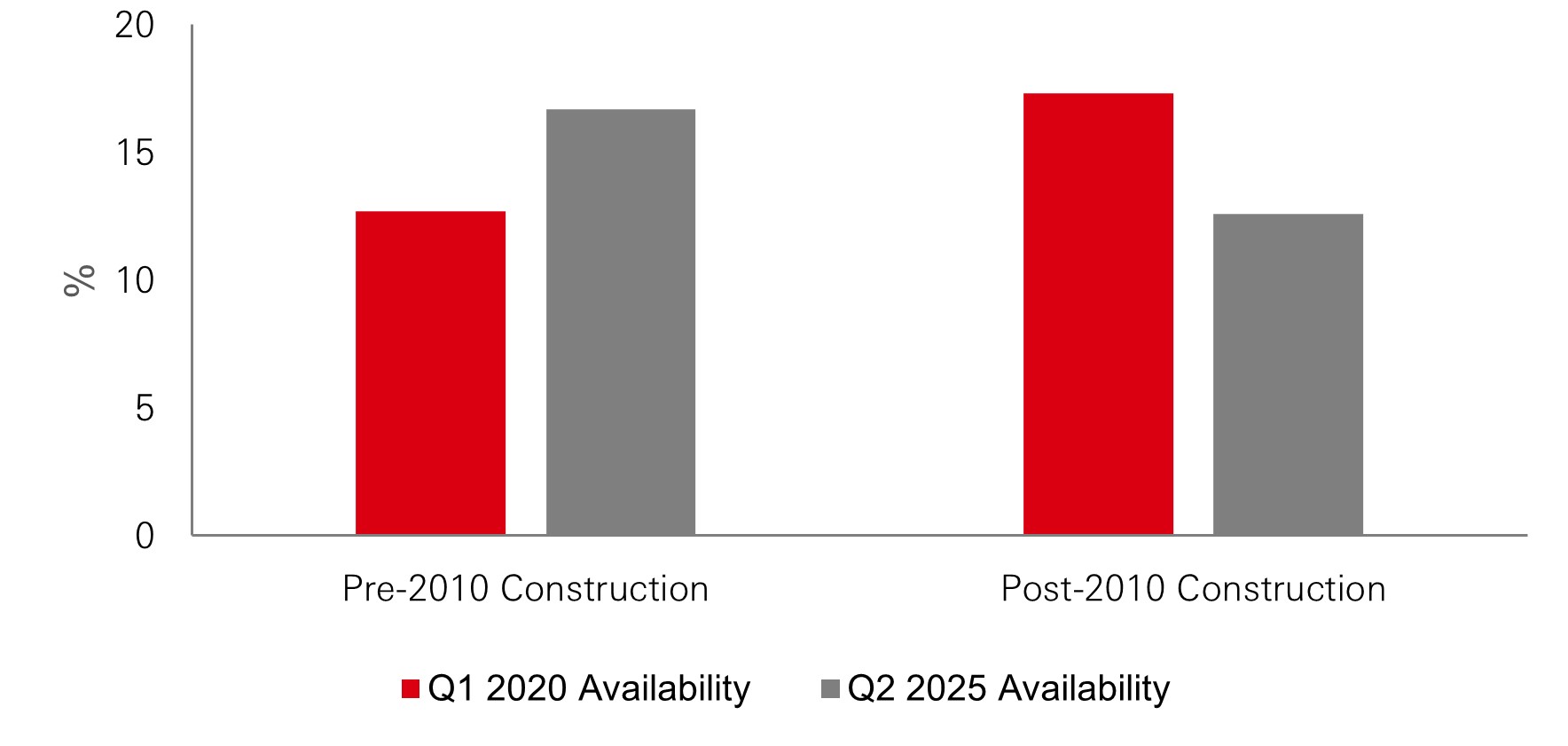
Source: Avison Young, HSBC Asset Management
Is now the time for CMBS to realign to the fundamentals?
When we look at CMBS spreads, not only do they remain wide of historic tights, but they are one of the widest sub-asset class within the Securitised Credit universe. This has been the result of the changing use of property which was fuelled further by COVID-19, the unprecedented speed and magnitude of interest rate hikes over 2022 and 2023 and President Trump’s trade policy implementations in 2025.
One can argue that the whole CMBS sector has been unfairly punished because of specific areas of CMBS that have come under pressure, as mentioned previously. From an asset allocation perspective, the right high quality CMBS securities with the same credit rating as high-quality corporate bonds are much more attractive at this point in the cycle because of the higher spread compensation on offer to investors.
Interestingly, since the GFC, commercial real estate debt has had better credit metrics such as lower loan to values (LTV), suggesting the sector is better able to survive stress in the market.
LTVs have fallen significantly below 20Y averages
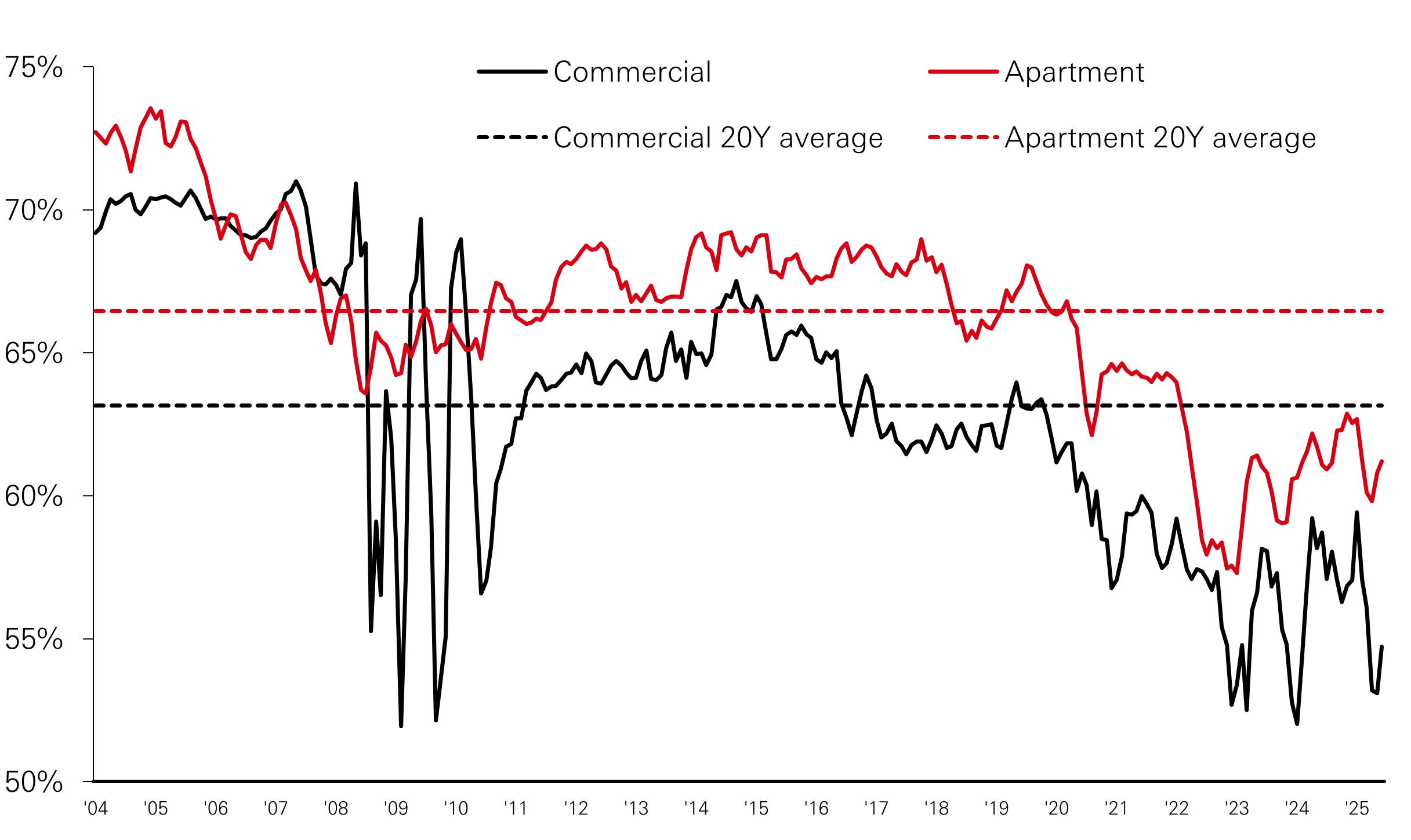
Source: Real Capital Analytics, Morgan Stanley, HSBC Asset Management. Data as at 30 June 2025.
What’s more, interest rates returning to more neutral levels has and will continue to ease pressure on the sector. When compared to equivalent rated corporate bonds and fixed rate ABS, CMBS provides a noticeably higher spread. As the chart below shows, as of 30 November 2025, the sector at an index level offers an asset swap spread of 113bps vs 96bps for fixed rate ABS and 84bps for AAA-A US corporates.
In fact, as can be seen below, the potential for spread compression to more normal trading levels is highest in CMBS when compared against fixed rate ABS as well as US investment grade corporates.
CMBS spreads are compelling versus similarly rated ABS and US corporates

Source: Bloomberg, HSBC Asset Management, as at 30 November 2025.
Conclusion
It is fair to say that investing in CMBS requires significant understanding, experience and research. However, if done correctly, investors stand to earn a significant complexity premium, participate in potential spread tightening and lock in the higher yields on offer compared to Investment Grade corporate bond securities. As we shift towards a neutral interest rate paradigm, the tide appears to be turning for an arguably undervalued sector.
Source: HSBC Asset Management
The level of yield is not guaranteed and may rise or fall in the future.
The views expressed above were held at the time of preparation and are subject to change without notice. For informational purposes only and should not be construed as a recommendation for any investment product or strategy.
Important information
For Professional Clients and intermediaries within countries and territories set out below; and for Institutional Investors and Financial Advisors in the US. This document should not be distributed to or relied upon by Retail clients/investors.
The value of investments and the income from them can go down as well as up and investors may not get back the amount originally invested. The performance figures contained in this document relate to past performance, which should not be seen as an indication of future returns. Future returns will depend, inter alia, on market conditions, investment manager’s skill, risk level and fees. Where overseas investments are held the rate of currency exchange may cause the value of such investments to go down as well as up. Investments in emerging markets are by their nature higher risk and potentially more volatile than those inherent in some established markets. Economies in Emerging Markets generally are heavily dependent upon international trade and, accordingly, have been and may continue to be affected adversely by trade barriers, exchange controls, managed adjustments in relative currency values and other protectionist measures imposed or negotiated by the countries and territories with which they trade. These economies also have been and may continue to be affected adversely by economic conditions in the countries and territories in which they trade.
The contents of this document may not be reproduced or further distributed to any person or entity, whether in whole or in part, for any purpose. All non-authorised reproduction or use of this document will be the responsibility of the user and may lead to legal proceedings. The material contained in this document is for general information purposes only and does not constitute advice or a recommendation to buy or sell investments. Some of the statements contained in this document may be considered forward looking statements which provide current expectations or forecasts of future events. Such forward looking statements are not guarantees of future performance or events and involve risks and uncertainties. Actual results may differ materially from those described in such forward-looking statements as a result of various factors. We do not undertake any obligation to update the forward-looking statements contained herein, or to update the reasons why actual results could differ from those projected in the forward-looking statements. This document has no contractual value and is not by any means intended as a solicitation, nor a recommendation for the purchase or sale of any financial instrument in any jurisdiction in which such an offer is not lawful. The views and opinions expressed herein are those of HSBC Asset Management at the time of preparation, and are subject to change at any time. These views may not necessarily indicate current portfolios' composition. Individual portfolios managed by HSBC Asset Management primarily reflect individual clients' objectives, risk preferences, time horizon, and market liquidity. Foreign and emerging markets. Investments in foreign markets involve risks such as currency rate fluctuations, potential differences in accounting and taxation policies, as well as possible political, economic, and market risks. These risks are heightened for investments in emerging markets which are also subject to greater illiquidity and volatility than developed foreign markets. This commentary is for information purposes only. It is a marketing communication and does not constitute investment advice or a recommendation to any reader of this content to buy or sell investments nor should it be regarded as investment research. It has not been prepared in accordance with legal requirements designed to promote the independence of investment research and is not subject to any prohibition on dealing ahead of its dissemination. This document is not contractually binding nor are we required to provide this to you by any legislative provision.
All data from HSBC Asset Management unless otherwise specified. Any third party information has been obtained from sources we believe to be reliable, but which we have not independently verified.
HSBC Asset Management is the brand name for the asset management business of HSBC Group, which includes the investment activities that may be provided through our local regulated entities. HSBC Asset Management is a group of companies in many countries and territories throughout the world that are engaged in investment advisory and fund management activities, which are ultimately owned by HSBC Holdings Plc. (HSBC Group). The above communication is distributed by the following entities:
- In Australia, this document is issued by HSBC Bank Australia Limited ABN 48 006 434 162, AFSL 232595, for HSBC Global Asset Management (Hong Kong) Limited ARBN 132 834 149 and HSBC Global Asset Management (UK) Limited ARBN 633 929 718. This document is for institutional investors only, and is not available for distribution to retail clients (as defined under the Corporations Act). HSBC Global Asset Management (Hong Kong) Limited and HSBC Global Asset Management (UK) Limited are exempt from the requirement to hold an Australian financial services license under the Corporations Act in respect of the financial services they provide. HSBC Global Asset Management (Hong Kong) Limited is regulated by the Securities and Futures Commission of Hong Kong under the Hong Kong laws, which differ from Australian laws. HSBC Global Asset Management (UK) Limited is regulated by the Financial Conduct Authority of the United Kingdom and, for the avoidance of doubt, includes the Financial Services Authority of the United Kingdom as it was previously known before 1 April 2013, under the laws of the United Kingdom, which differ from Australian laws;
- in Bermuda by HSBC Global Asset Management (Bermuda) Limited, of 37 Front Street, Hamilton, Bermuda which is licensed to conduct investment business by the Bermuda Monetary Authority;
- in Chile: Operations by HSBC's headquarters or other offices of this bank located abroad are not subject to Chilean inspections or regulations and are not covered by warranty of the Chilean state. Obtain information about the state guarantee to deposits at your bank or on www.cmfchile.cl;
- in Colombia: HSBC Bank USA NA has an authorized representative by the Superintendencia Financiera de Colombia (SFC) whereby its activities conform to the General Legal Financial System. SFC has not reviewed the information provided to the investor. This document is for the exclusive use of institutional investors in Colombia and is not for public distribution;
- in France, Belgium, Netherlands, Luxembourg, Portugal, Greece, Finland, Norway, Denmark and Sweden by HSBC Global Asset Management (France), a Portfolio Management Company authorised by the French regulatory authority AMF (no. GP99026);
- in Germany by HSBC Global Asset Management (Deutschland) GmbH which is regulated by BaFin (German clients) respective by the Austrian Financial Market Supervision FMA (Austrian clients);
- in Hong Kong by HSBC Global Asset Management (Hong Kong) Limited, which is regulated by the Securities and Futures Commission. This video/content has not be reviewed by the Securities and Futures Commission;
- in India by HSBC Asset Management (India) Pvt Ltd. which is regulated by the Securities and Exchange Board of India;
- in Italy and Spain by HSBC Global Asset Management (France), a Portfolio Management Company authorised by the French regulatory authority AMF (no. GP99026) and through the Italian and Spanish branches of HSBC Global Asset Management (France), regulated respectively by Banca d’Italia and Commissione Nazionale per le Società e la Borsa (Consob) in Italy, and the Comisión Nacional del Mercado de Valores (CNMV) in Spain;
- in Malta by HSBC Global Asset Management (Malta) Limited which is regulated and licensed to conduct Investment Services by the Malta Financial Services Authority under the Investment Services Act;
- in Mexico by HSBC Global Asset Management (Mexico), SA de CV, Sociedad Operadora de Fondos de Inversión, Grupo Financiero HSBC which is regulated by Comisión Nacional Bancaria y de Valores;
- in the United Arab Emirates, Qatar, Bahrain & Kuwait by HSBC Global Asset Management MENA, a unit within HSBC Bank Middle East Limited, U.A.E Branch, PO Box 66 Dubai, UAE, regulated by the Central Bank of the U.A.E. and the Securities and Commodities Authority in the UAE under SCA license number 602004 for the purpose of this promotion and lead regulated by the Dubai Financial Services Authority. HSBC Bank Middle East Limited is a member of the HSBC Group and HSBC Global Asset Management MENA are marketing the relevant product only in a sub-distributing capacity on a principal-to-principal basis. HSBC Global Asset Management MENA may not be licensed under the laws of the recipient’s country of residence and therefore may not be subject to supervision of the local regulator in the recipient’s country of residence. One of more of the products and services of the manufacturer may not have been approved by or registered with the local regulator and the assets may be booked outside of the recipient’s country of residence.
- in Peru: HSBC Bank USA NA has an authorized representative by the Superintendencia de Banca y Seguros in Perú whereby its activities conform to the General Legal Financial System - Law No. 26702. Funds have not been registered before the Superintendencia del Mercado de Valores (SMV) and are being placed by means of a private offer. SMV has not reviewed the information provided to the investor. This document is for the exclusive use of institutional investors in Perú and is not for public distribution;
- in Singapore by HSBC Global Asset Management (Singapore) Limited, which is regulated by the Monetary Authority of Singapore. The content in the document/video has not been reviewed by the Monetary Authority of Singapore;
- In Switzerland by HSBC Global Asset Management (Switzerland) AG. This document is intended for professional investor use only. For opting in and opting out according to FinSA, please refer to our website; if you wish to change your client categorization, please inform us. HSBC Global Asset Management (Switzerland) AG having its registered office at Gartenstrasse 26, PO Box, CH-8002 Zurich has a licence as an asset manager of collective investment schemes and as a representative of foreign collective investment schemes. Disputes regarding legal claims between the Client and HSBC Global Asset Management (Switzerland) AG can be settled by an ombudsman in mediation proceedings. HSBC Global Asset Management (Switzerland) AG is affiliated to the ombudsman FINOS having its registered address at Talstrasse 20, 8001 Zurich. There are general risks associated with financial instruments, please refer to the Swiss Banking Association (“SBA”) Brochure “Risks Involved in Trading in Financial Instruments;
- in Taiwan by HSBC Global Asset Management (Taiwan) Limited which is regulated by the Financial Supervisory Commission R.O.C. (Taiwan);
- in Turkiye by HSBC Asset Management A.S. Turkiye (AMTU) which is regulated by Capital Markets Board of Turkiye. Any information here is not intended to distribute in any jurisdiction where AMTU does not have a right to. Any views here should not be perceived as investment advice, product/service offer and/or promise of income. Information given here might not be suitable for all investors and investors should be giving their own independent decisions. The investment information, comments and advice given herein are not part of investment advice activity. Investment advice services are provided by authorized institutions to persons and entities privately by considering their risk and return preferences, whereas the comments and advice included herein are of a general nature. Therefore, they may not fit your financial situation and risk and return preferences. For this reason, making an investment decision only by relying on the information given herein may not give rise to results that fit your expectations.
- in the UK by HSBC Global Asset Management (UK) Limited, which is authorised and regulated by the Financial Conduct Authority;
- and in the US by HSBC Global Asset Management (USA) Inc. which is an investment adviser registered with the US Securities and Exchange Commission.
- In Uruguay, operations by HSBC's headquarters or other offices of this bank located abroad are not subject to Uruguayan inspections or regulations and are not covered by warranty of the Uruguayan state. Further information may be obtained about the state guarantee to deposits at your bank or on www.bcu.gub.uy.
Copyright © HSBC Global Asset Management Limited 2025. All rights reserved. No part of this publication may be reproduced, stored in a retrieval system, or transmitted, on any form or by any means, electronic, mechanical, photocopying, recording, or otherwise, without the prior written permission of HSBC Global Asset Management Limited.
Content ID: D060400_V1.0; Expiry Date: 31.12.2026


